Dream Brush
Write a character in water.
Watch it become a painting.
Prelude
What if a brushstroke were a word, and the word the gesture that brings a picture into being?
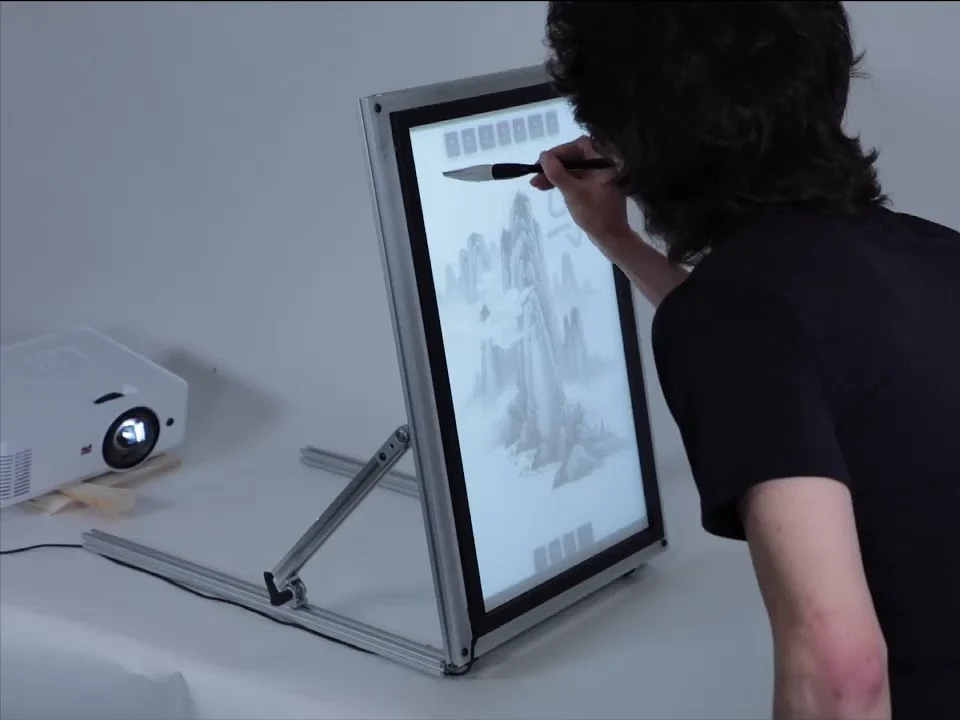
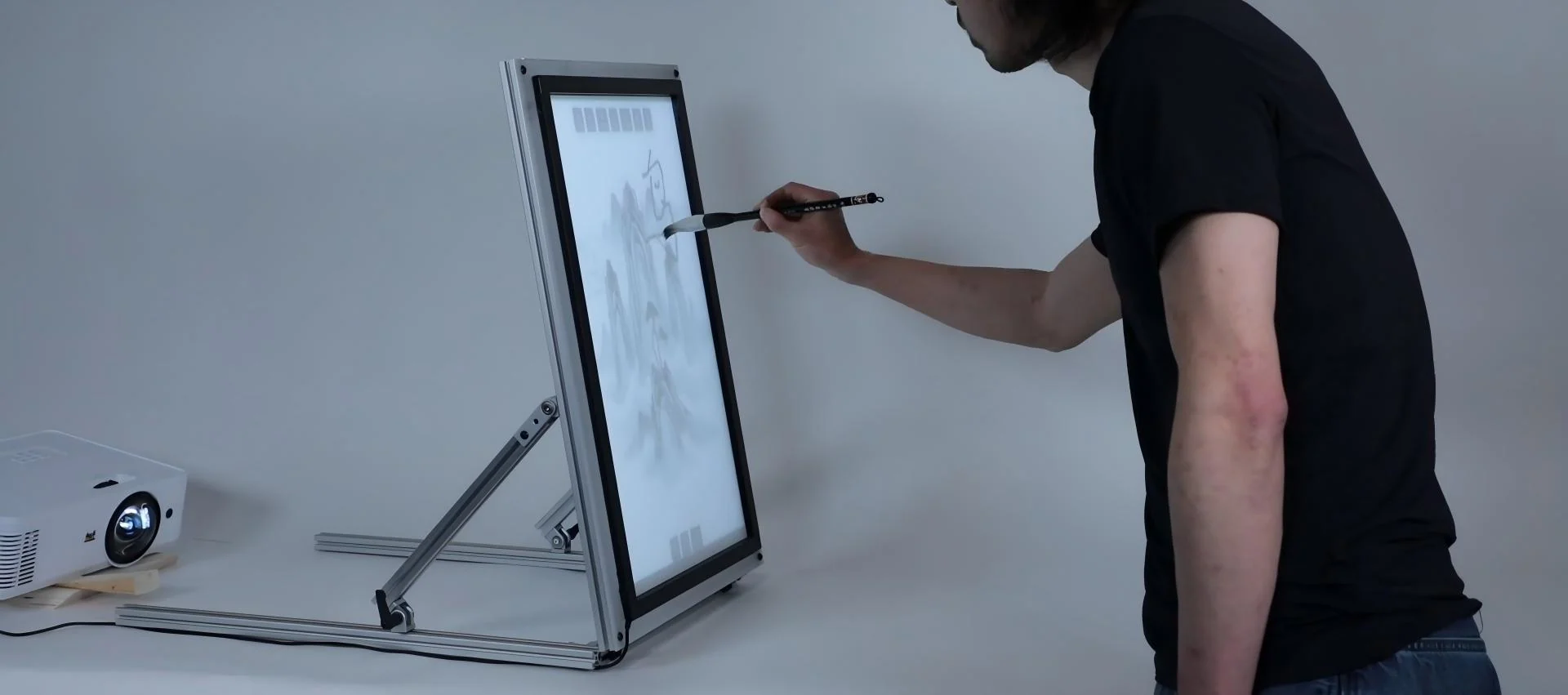
Dream Brush is a generative painting experience. You write Chinese characters with a real calligraphy brush, dipped only in water, on a canvas that stands on an easel. The canvas shows the trace of your stroke, then lets it fade as if drying. In its place the system paints: each character becomes a motif of Chinese painting, with sound.
Generative tools are pushing creative work toward detached prompting. Chinese characters offer another way in. A single mark can carry meaning and still be a gesture and a picture, so what you write, where you write it and how large all steer what appears.
书画异名而同体
Writing and painting have different names, but one body.
Zhang Yanyuan 张彦远, Records of Famous Paintings of All Dynasties 《历代名画记》, 847
Try it
Write, then wait.
A working model of the canvas. Choose a character and write it anywhere on the paper, with a mouse, a finger or a pen, or tap and it is written for you. Where you write, and how large, is where and how large the painting changes.
Choose a character, then write it on the paper.
A model, not the installation. These motifs are painted by your browser, and nothing here reads your handwriting. The installation recognises the written character with a vision model and paints it with an image model.
Four rules
One character, four decisions.
Each character is read through four coupled constraints. One gesture carries what a screen would split into a tool, a prompt and its parameters.
-
Size
How large you write is how much of the painting changes.
-
Location
Where you write is where the change happens.
-
Context
What is already there decides whether a character replaces, modifies or adds.
-
Semantics
Some characters are pictures. Others change the weather, or the hour.
A session
First a mountain. Then the sun.
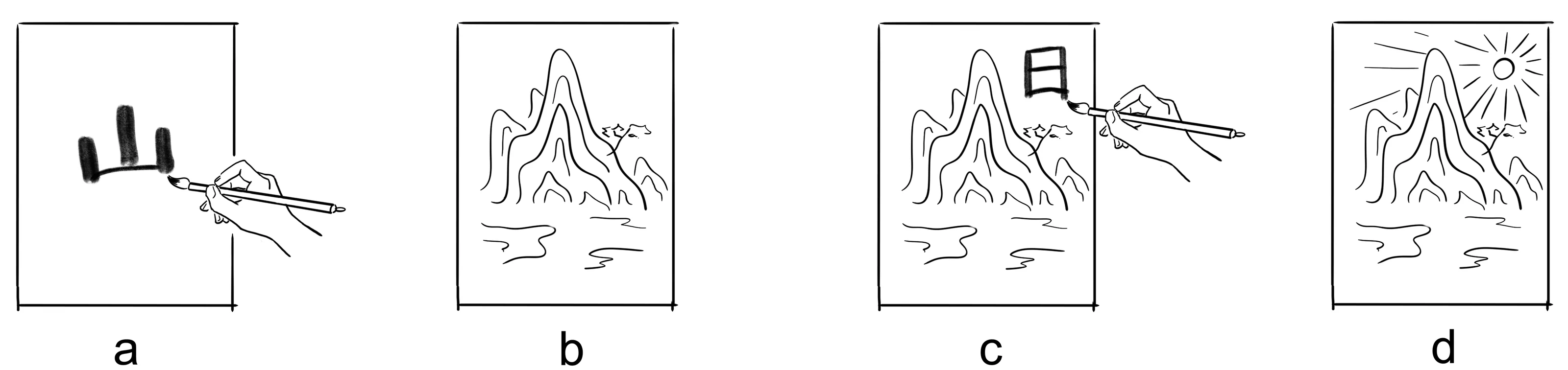
- Write 山, mountain, large across the paper.
- A great mountain becomes the main element of the scene.
- Write 日, sun, small in a corner.
- The sun appears there, at that size, and the mountain stays.
The instrument
A brush, a cup of water, an easel of light.
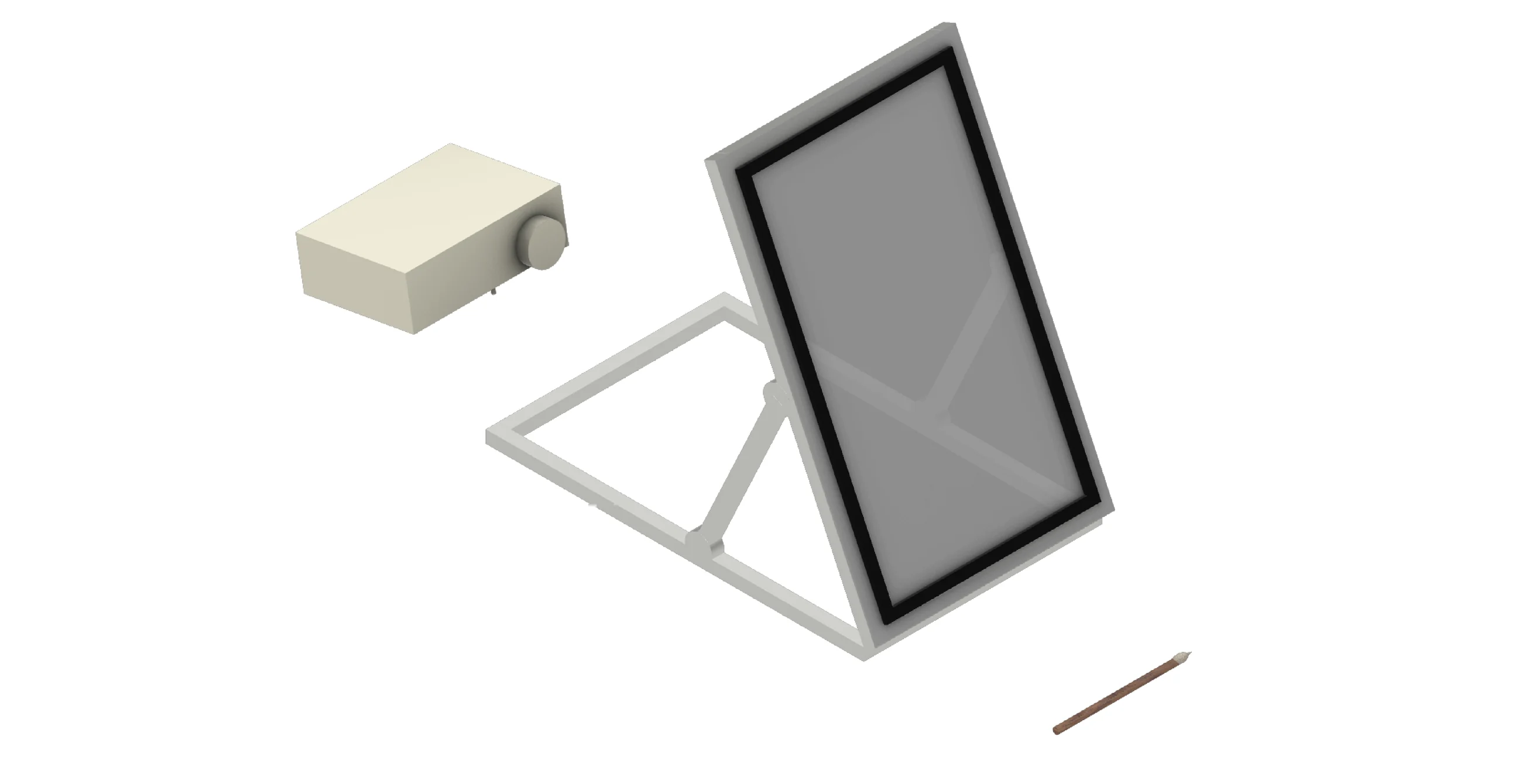
- Canvas
- Semi-translucent matte acrylic, back-projected, so the trace glows from within.
- Sensing
- An infrared multi-touch frame around the canvas detects the brush.
- Brush
- A Chinese calligraphy brush and a cup of water: the feel of brushing, without pigment.
- Light
- A projector behind the canvas, on an adjustable aluminium easel.
- Sound
- A speaker beside the easel.
- Mind
- A computer coordinating sensing, recognition, painting and sound.
Ten seconds
The waiting is the drying.
Painting a new image takes about ten seconds, long enough to collapse into waiting. So the stroke shows at once and fades like water drying while the painting is made. The delay becomes part of the work: a rhythm of mark, fade and response, closer to following a material than executing a plan.
The stroke appears
The water dries
A vision model reads the character
An image model paints inside the stroke’s bounds
A sound model composes
The painting changes, the sound plays
Reflections
What people did with it.
-
Easier than a prompt.
People wrote straight into the area they wanted, instead of describing a place in words. Many characters are near-square, so turning, scaling or combining them reshapes the target.
-
A shared game.
Two groups of high school students agreed together on what to paint next, and cheered when an update landed. When it missed, the gap between intention, recognition and painting became a joke and a puzzle to solve. Some tested the edges with anachronisms and negations: airplane, train, nothing, cancellation.
-
Where it goes next.
Shrink the rectangle to the written shape, so irregular areas can be targeted. Let changes bleed in like ink, not cut. Write short prose or poetry for more abstract answers. Carry the idea to other writing systems.
The name
Flowers from the tip of a brush.
Dream Brush echoes an old idiom, 梦笔生花. As a boy, the poet Li Bai dreamt that flowers bloomed from the tip of his brush.
- Year
- 2026
- Lab
- MIT Media Lab, Tangible Media Group
- Team
- Chuanqi Sun*, Yuhan Wang*, Quincy Kuang, Hiroshi Ishii * equal contribution
- Medium
- Interactive installation; generative painting with Chinese calligraphy
- Built with
- Infrared multi-touch frame, vision model, image model, text-to-sound model, rear projection
- Lineage
- I/O Brush (Ryokai, Marti, Ishii, 2004), a brush that picks up the world as ink