hdr · d3 data-driven design · 2025
CODEX-2AI MODEL
BUILDER
SYNTH-2AI DATA
VISUALIZER
two ai tools for designers. one builds the model you draw and describe. the other reads a building’s data and draws the chart you ask for.
01
see it work
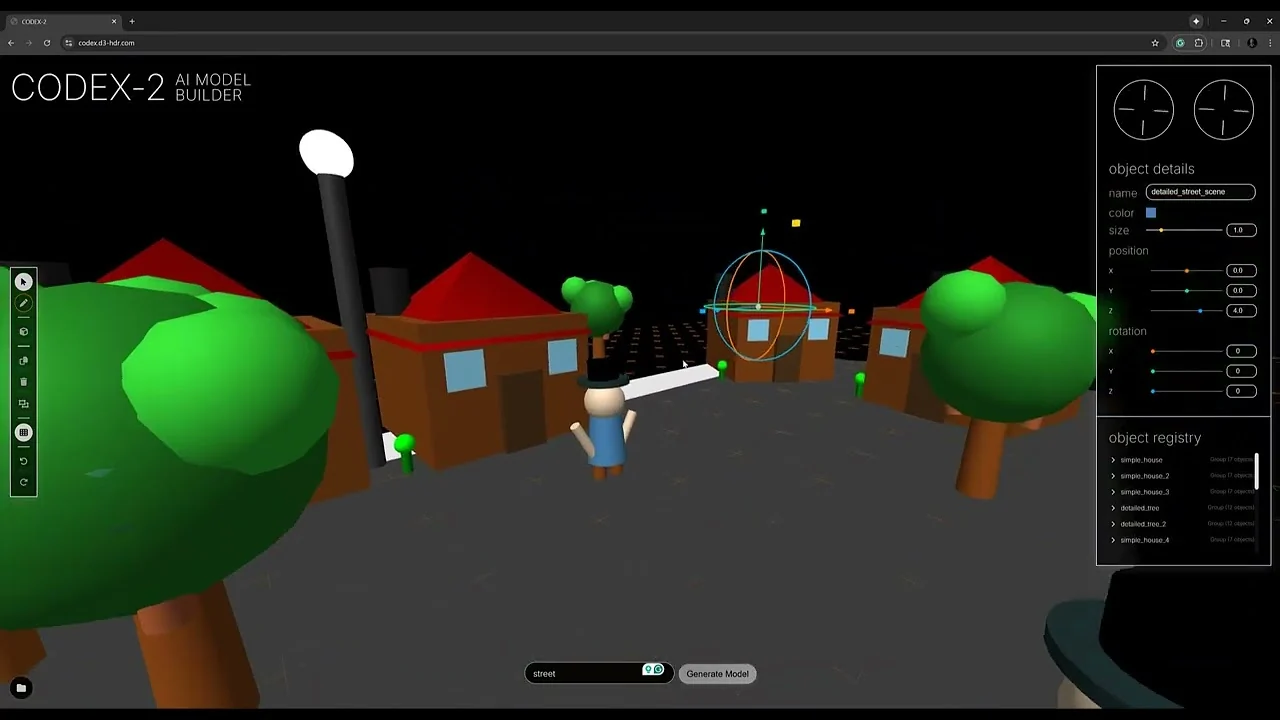
codex-2, building a street from prompts.
tool 01 / 02
CODEX-2AI MODEL
BUILDER
human–ai co-creation in cad. model with the tools you know, and let ai generate, edit and iterate on the model with you.
CODEX explores the interaction patterns of future AI CAD tools, merging AI 3D generation into the CAD modeling workflow. It was the first research and prototype for AI software products at the D3 group.
open codex-202
cad is precise. and slow.
a study of the tools designers use every day.
-
precise
The model format defines every boundary exactly.
-
detailed
The process gives control over every dimension.
-
manual
Every step needs a hand on it, from first line to last.
the pain point
the hours go into the hundred ordinary models around the one that matters.
Much of the time is spent building standard models that don’t need the most care, and aren’t the core of the design.
the idea
ai-powered cad.
AI can produce the standard models without anyone touching every detail, so human effort goes into the designs that need it.
03
a mesh, or a model?
ai can already make 3d. what it hands back is the problem. the same house, both ways:
ai mesh generation
a skin of triangles
Today’s AI 3D generation mostly returns coarse, low-fidelity meshes with poor topology: fine to look at, not ready to build.
- method
- networks (GAN, GCN, patches) that output the mesh directly
- examples
- GET3D, TripoSR
- edit as cad
- no
ai cad generation
a list of commands
A transformer writes CAD commands and the CAD software builds them: a watertight, dimensionally exact model you can keep editing.
- method
- a transformer writes the commands; the software builds the shapes
- example
- DeepCAD
- edit as cad
- yes
drag either one to turn both.
so codex-2 joins two workflows
- ai mesh generationfast, from a prompt
- cad modelingexact, editable
- ai cad generationthe speed of one, the format and quality of the other
what was out there, summer 2025
| platform | what it is | hands back |
|---|---|---|
| Meshy.ai | rapid 3D generation, from text or from an image | a mesh |
| Spline | online 3D modeling and UI design, with 3D generation added | a mesh |
| Tencent Hunyuan | multi-modal generation, with self-defined workflows | a mesh |
| CODEX-2 | a CAD modeler with an AI agent at its centre | named groups of CAD primitives |
04
three functions, three promises
from what users need to what the interface must be.
pain point
CAD tools lack automation and agency.
main goal
Use AI to enhance the modeling workflow, and free people from repetitive, standard routines.
critical functions
design goals
basic cad
The essential CAD functions, so a model can be edited the usual way.
familiar
Keep CAD’s interface elements, so CAD users can learn it and try it at once.
ai agent
The core: write the commands and build the model from a prompt.
intuitive
Make talking to the AI easy to understand and quick to use.
merging system
One system for what the AI makes and what you model by hand.
robust
A registry and document system that link AI models and CAD models without seams.
05
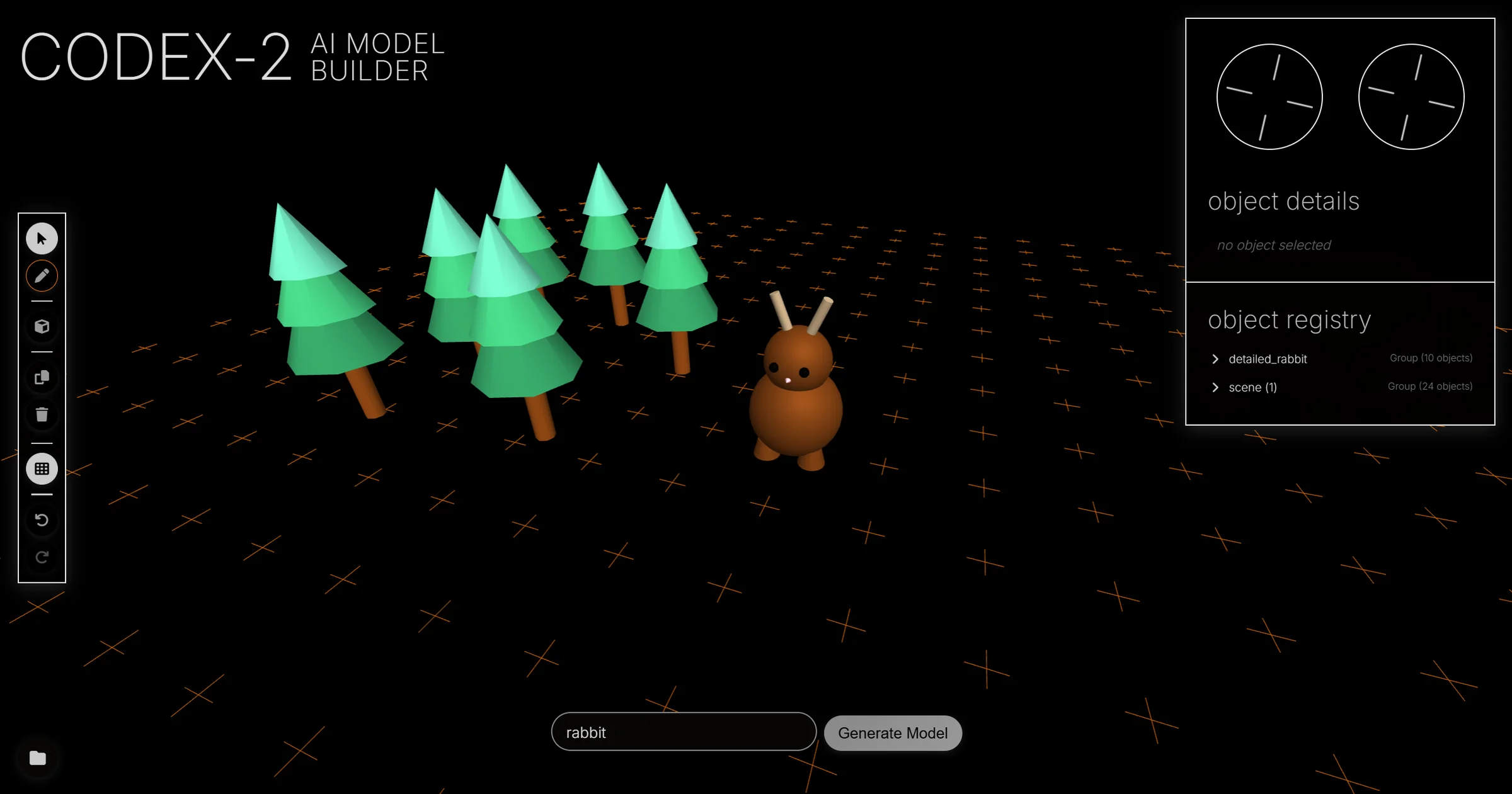
the interface
cad you already know, with an agent at the centre. point at a part.
06
try codex-2
a working model of the interface, built around the magic pen: draw around something, then say what you want. start with the three tasks the pen was designed for.
what the model writes
a model of the interface: fixed recipes stand in for the AI, and nothing is sent anywhere. In CODEX-2 a language model writes these commands, and the scene is built from them.
tool 02 / 02
SYNTH-2AI DATA
VISUALIZER
a building’s data, as the chart you ask for. ai as a helper in reading data and presenting it.
SYNTH reads a CSV of project data together with its 3D model, and turns the data into AI-generated visualizations from a prompt: a prototype of AI making today’s data-visualization software faster and more customizable.
open synth-2- model.obj
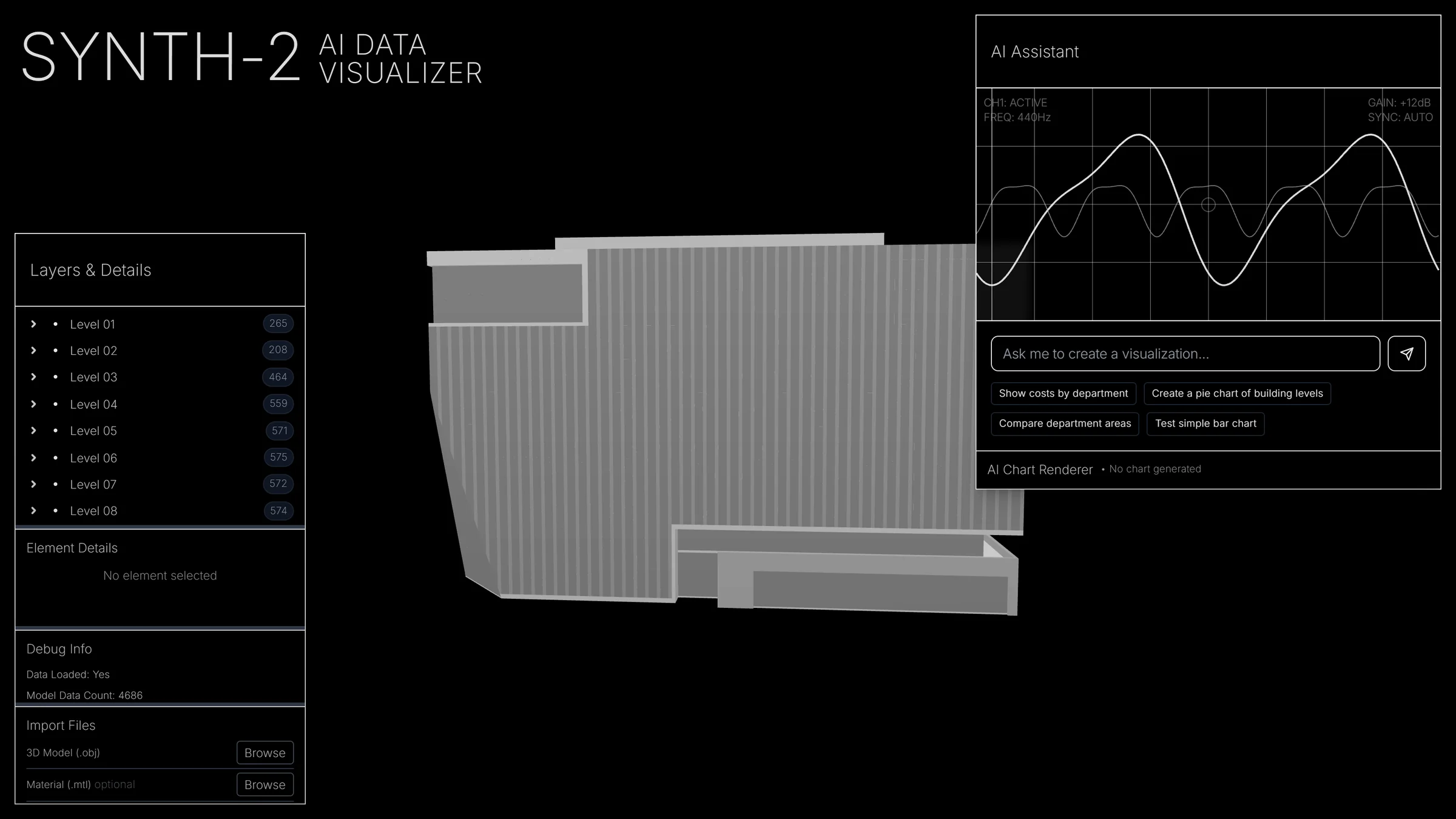
the building, element by element. 4,686 of them here.
- data.csv
a row of data for each element.
- model.mtl
materials. optional.
- linked
each row finds its element; elements sort into layers by level.
- asked
you ask in words, or pick a suggestion.
- drawn
the AI chart renderer draws the answer beside the model.
07
the interface
the model in the middle, its data on the left, the assistant on the right. point at a part.
08
try synth-2
a working model, with the sample building’s real element counts. ask the assistant, or point at a floor: the model and the chart answer together.
a model of the interface with the sample building’s real counts (4,686 elements, from the live SYNTH-2). The building is drawn as stacked levels, not its real form; nothing is sent anywhere.
09
made at hdr
a summer internship in the D3 group, 2025.

HDR is one of the world’s leading integrated design and engineering firms, with offices in over 200 cities.
Its work spans architecture, urban planning, transportation, healthcare and scientific research, and it is known for interdisciplinary collaboration and new technology.
D3 (Data-Driven Design) is HDR’s digital innovation hub: computational design, data visualization and AI-powered design tools. Architects, programmers and data scientists work together there on products such as AI CAD plugins and design decision-support platforms, to make design more efficient, intelligent and sustainable.
10
record
- time
- 2025
- program
- HDR Inc., D3 (Data-Driven Design)
- leader
- Matt Goldsberry
- work
- research, UI/UX design and prototypes of two AI software products
- codex-2
- codex.d3-hdr.com
- synth-2
- synthesizer.d3-hdr.com