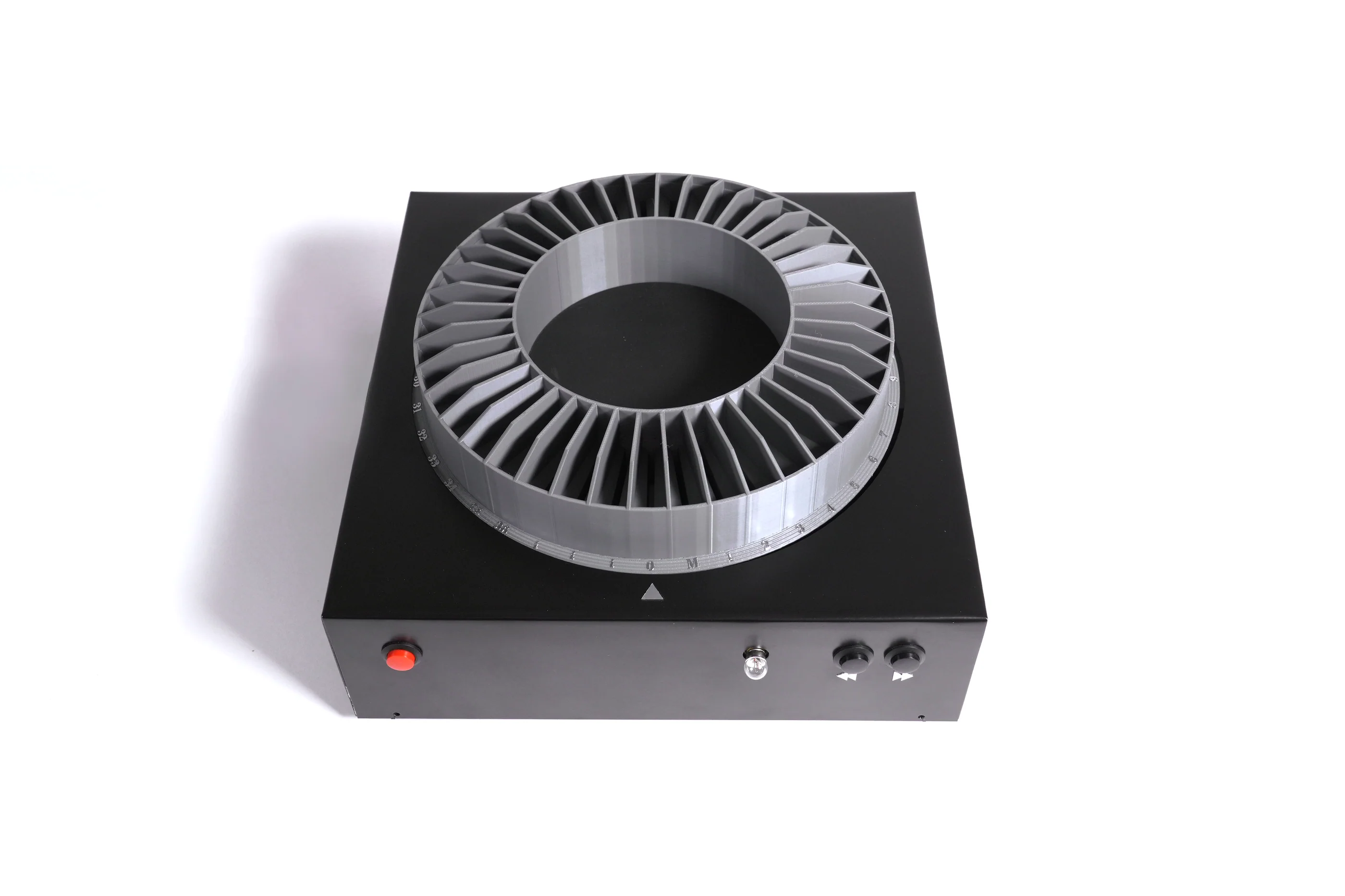
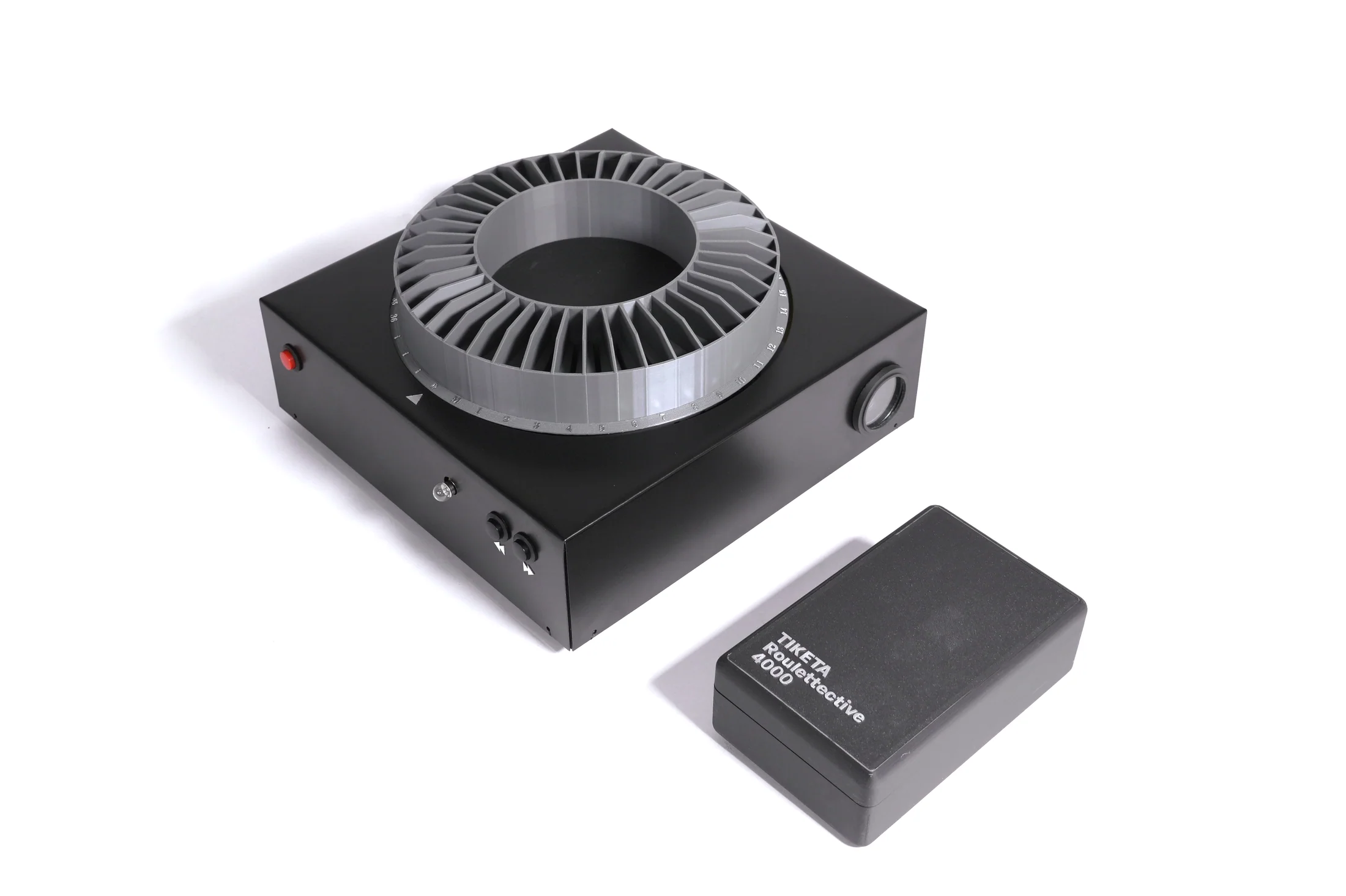
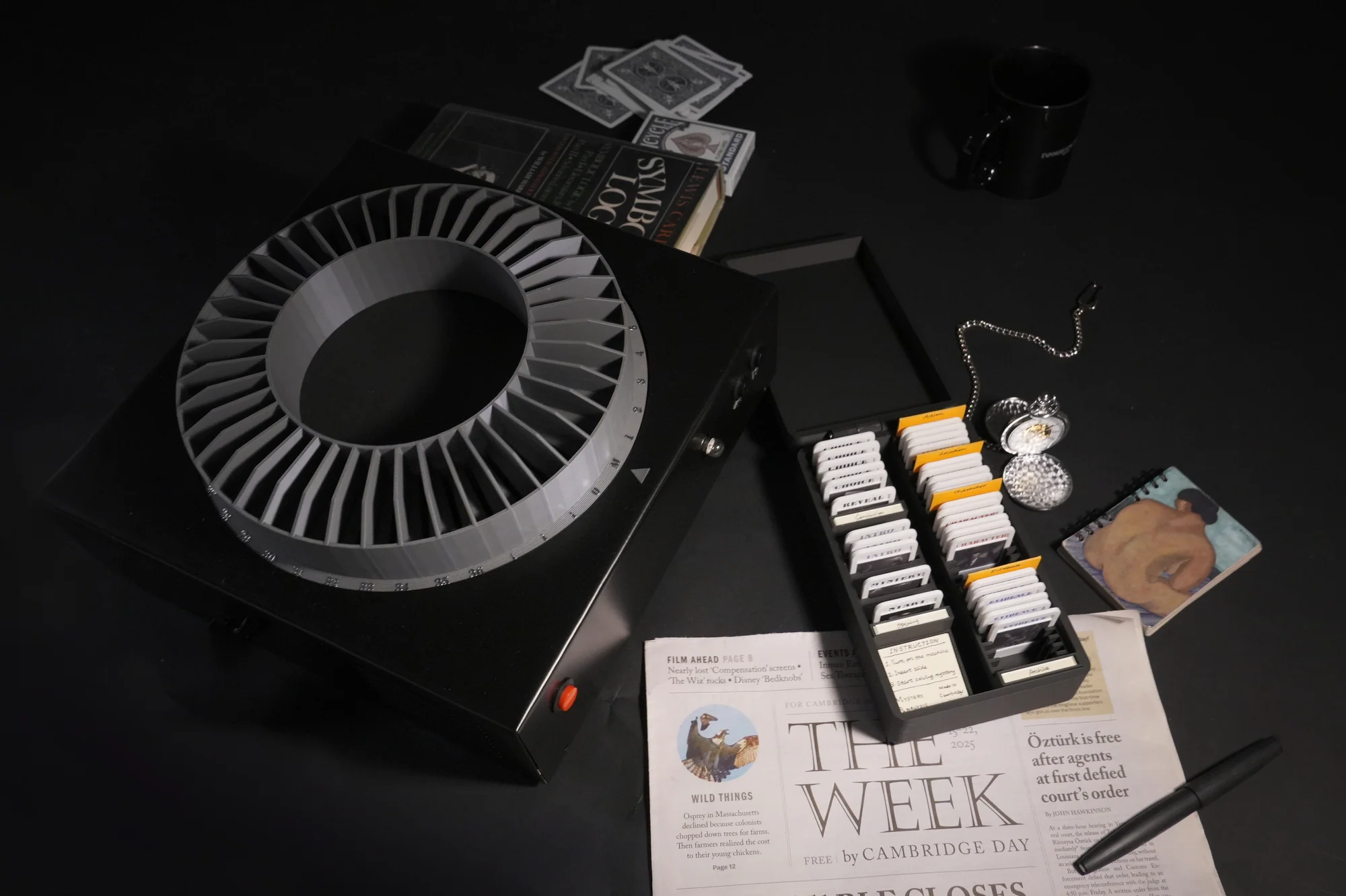
Roulettective: a black box carrying a grey 3D-printed carousel tray, with a red reset button, an indicator bulb and back and forward buttons

a forgotten slide projector,
re-invented as an ai detective.

  • neurips 2025creative ai track
  • uist 2025adjunct · busan
  • mit 4.044interaction intelligence
play the simulator

01overview

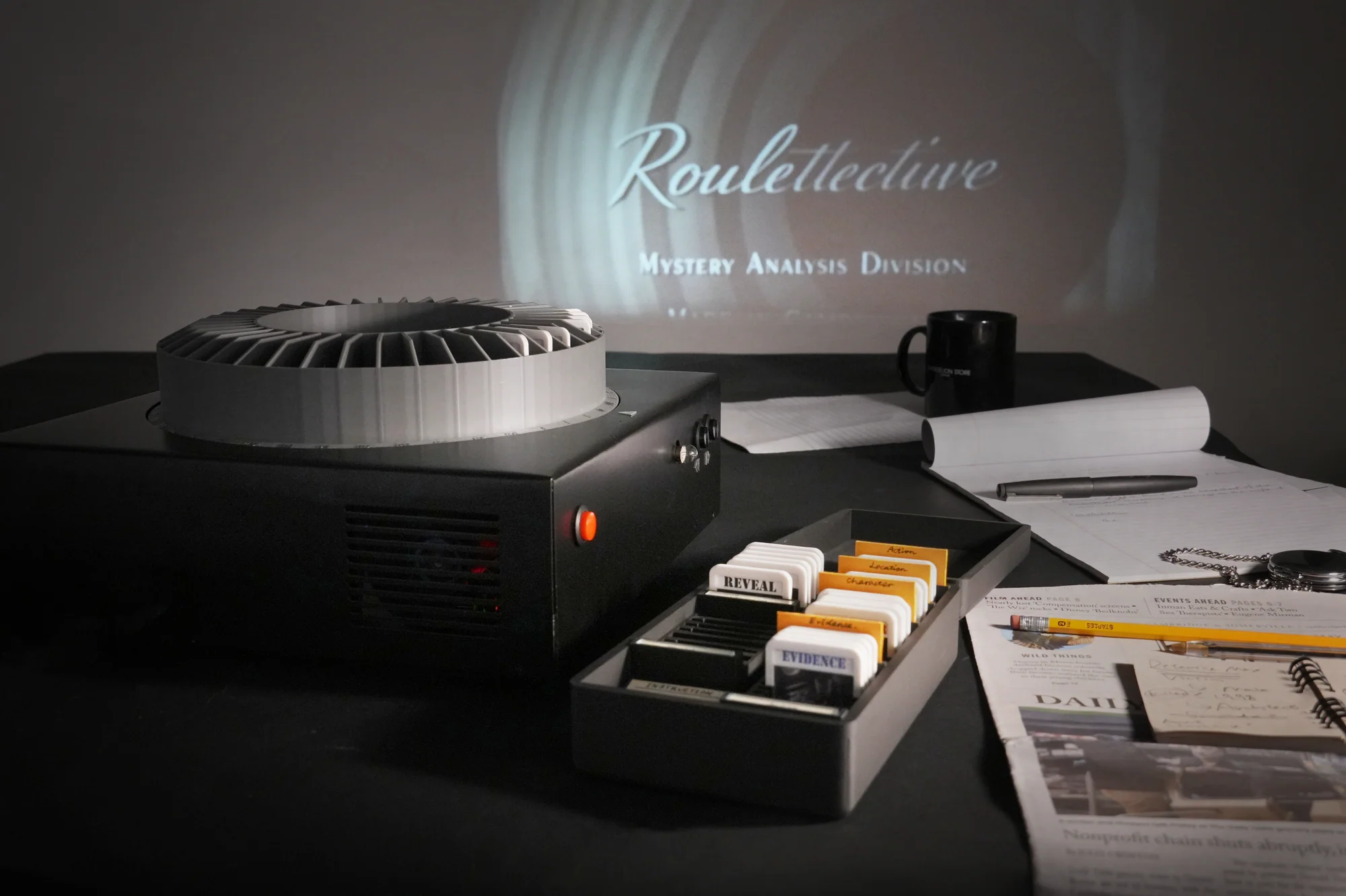
roulettective is the mastermind of the mystery analysis division. you collect fragments of truth on slides. it associates them.

Insert a slide, press forward, and the carousel clicks one slot on. GPT-4o writes what that slide reveals and DALL·E 3 develops a film-noir still to go with it. When two clues turn out to be connected, a bulb lights. There is no screen to tap and no prompt to type: the slides are the prompts.

It is also a method. AI repurposing takes an object that computing left behind, studies what it once meant, and gives it a new use. The Kodak Carousel already had what a detective game needs: a sequence, a beam of light, and a click you can feel.

  1. 1961kodak launches the carousel slide projector.
  2. 2004production ends. powerpoint takes the slideshow.
  3. 2007mad men calls it “the carousel”, a machine for time.
  4. 2025roulettective. the carousel learns to think.

02anatomy

everything the projector had, rewired.

The original's three gestures stay: press a button, insert a slide, watch the light. What happens behind them is new.

Roulettective from above at three-quarters, with its archive box of slides beside it
  1. carouselA 3D-printed tray with a slot for every slide. A Geneva drive turns it exactly one slot per press.
  2. gate ▲The slot under the marker is the one in play. A servo lifts the slide, the tray turns, and the slide drops back so its RFID tag can be read.
  3. resetRed, on purpose. Winds the tray back to slot zero, counting every turn it made.
  4. indicator bulbLights when the AI links a new clue to an old one. Go back, and the earlier slide has changed.
  5. ◀◀ back · forward ▶▶The projector's own navigation, kept as it was. Forward plays the next slide; back revisits.
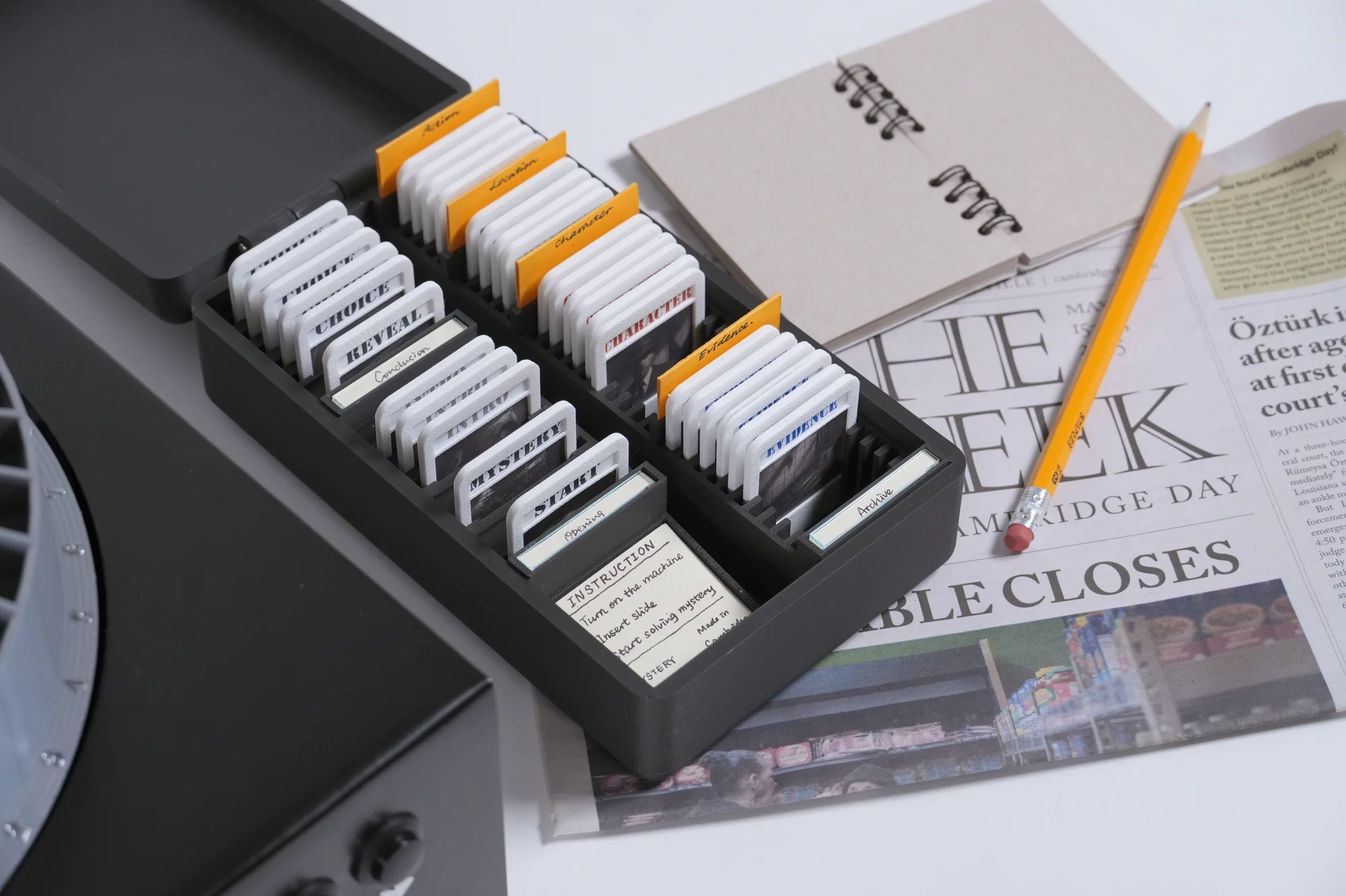
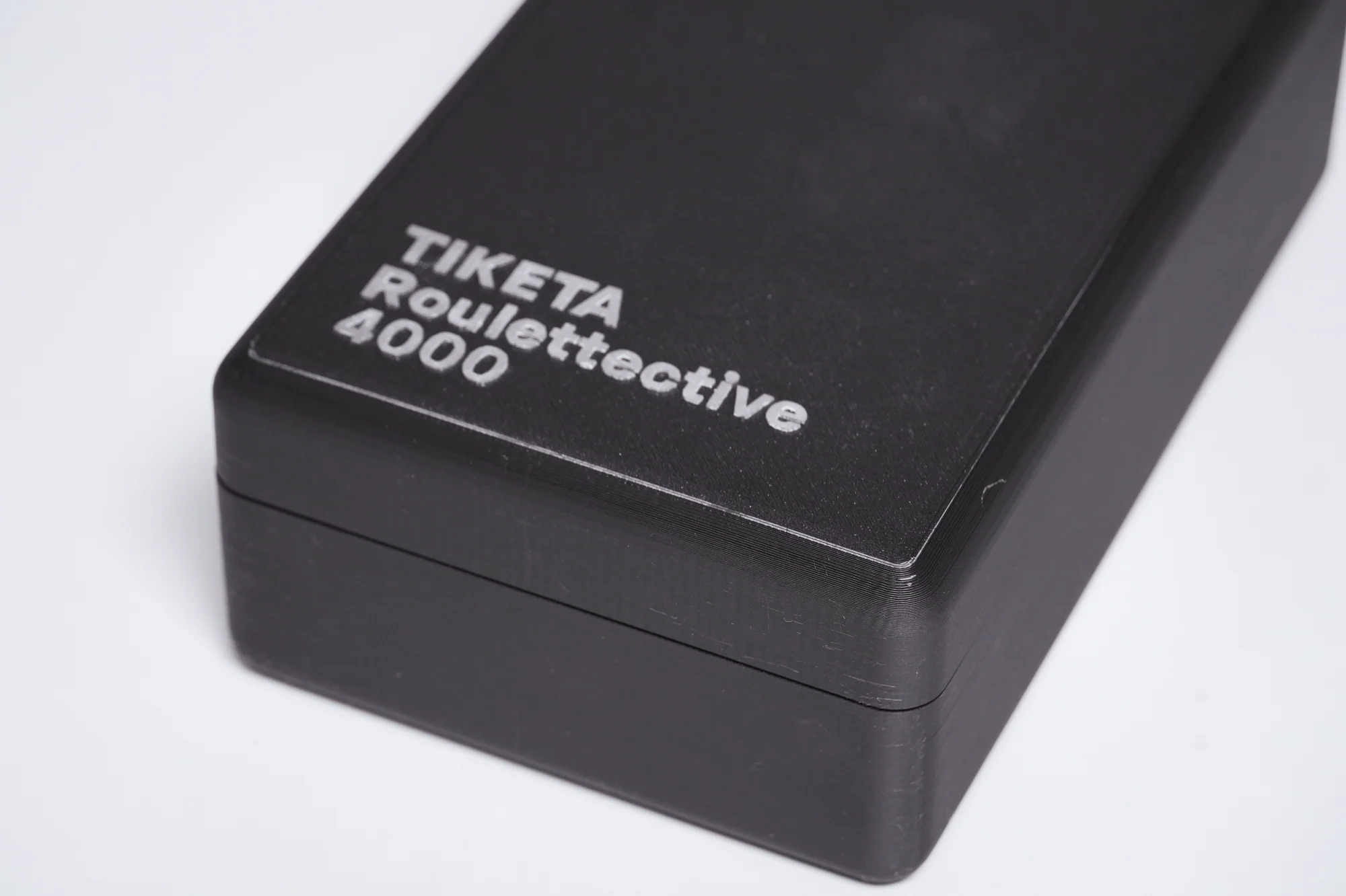
  6. archive box“TIKETA Roulettective 4000”. Holds 30 RFID-tagged slides, sorted by kind.

03how to play

open a case. try it here.

A working model of the machine. Insert slides from the archive box, press forward, and watch the bulb. On the real machine GPT-4o writes a new case every game; this one is pre-written so it runs in your browser.

mystery analysis division

Insert a MYSTERY slide, then press forward ▶▶.

  1. standby
  2. case
  3. explore
  4. associate
  5. reveal
  6. closed
reset
bulb
back
forward

slot 00 · standby

archive box: click a slide to load it into the next free slot

keys: F forward · B back · R reset · M E C L A V insert · 1–5 choose. The same letters the machine's Arduino types into the game.

  1. standbyThe agency logo, with noir jazz playing. Back reads the detective's guide.
  2. caseA Mystery slide opens a case: four sentences, one scene, no suspects yet.
  3. exploreEvidence, Character, Location and Action slides each ask the AI for one new fact.
  4. associateWhen a new fact connects to an old one, the bulb lights. Go back: that slide has been rewritten.
  5. revealWith four cards in play, a Reveal slide lists five theories. One is false.
  6. resetExpose the lie to close the case. Reset winds the tray home for the next one.

04the slides

a slide is a prompt you can hold.

Each slide carries an RFID tag that names a kind of question, not a fixed picture. The same Evidence slide turns up a different clue in every case. Underneath each one is a rule the AI has to follow.

  • Mmys · 01

    mystery

    “Exactly four sentences. One scene. Do not include any suspects.”

    opens a case
  • Eevd · 06

    evidence

    “One physical clue. Focus on what's observed, not what it means.”

    up to 6 per case
  • Cchr · 05

    character

    “Introduce one witness: name, role, background. No quotes.”

    up to 5 per case
  • Lloc · 04

    location

    “One place, one distinctive detail. It may jog a witness's memory.”

    up to 4 per case
  • Aact · 06

    action

    “One investigation step. It may upgrade a piece of evidence, or destroy it.”

    up to 6 per case
  • Vrev · 01

    reveal

    “Exactly five theories. Four true, one false. Plausible but wrong.”

    after 4 cards

+ choice slides 1–5 point at the false theory. + 3 instruction slides explain the game. 30 tagged slides in all.

05association

the bulb is the ai thinking out loud.

After every new card, GPT-4o compares it with up to three earlier ones and rates the connection from 0 to 1. At 0.75 or above, the earlier slide is rewritten and the bulb lights. There are at most three links per case, so the story stays solvable.

pick a pair of clues ↓

  • witness recants
  • evidence upgraded
  • evidence destroyed
  • location triggers recall

0.00awaiting input

Choose a pair to see how the machine rates it.

example ratings, from the simulator's case

06system

inside: a keyboard, a projector and two models.

The Arduino Pro Micro presents itself to the computer as a keyboard. Every button press and every slide read is typed into the game as a single letter. The game answers back over Web Serial to switch the bulb.

System diagram: slide tokens, buttons and the limit switch feed an Arduino Pro Micro, which types keystrokes into the browser game; the game calls GPT-4o and DALL·E 3 and drives the projector, speaker and, via Web Serial, the indicator bulb. keystrokes web serial “1” / “0” slide tokenrfid tag · ×30 buttons◀◀ · ▶▶ · reset limit switchoptical · 1 pulse / turn rc522 reader13.56 mhz rfid arduinopro microusb keyboardweb serialstep · dir · servolamp pin 7 servolifts the slide nema-17 + genevaone turn = one slot gamep5.js · browsercase memoryassociation ≥ 0.75prompt filterprompt summary gpt-4ocase · clues · links · theories dall·e 31024² film-noir stills projectorimage + text speakermusic while it thinks indicator bulblit on a strong link

hover a part to trace what it talks to.


07mechanism

one press, one turn, one slot.

The original Kodak was a precise optical instrument, and the game depends on that precision: every slide has to stop exactly at the gate. A Geneva drive turns the stepper's continuous rotation into clean, indexed steps, and locks the tray in place between them.

crank
0°
tray
0.0°
state
locked

tray angle against crank angle: it moves for 120° of every turn, then holds still. (diagram uses 6 slots for clarity.)

  1. liftThe servo raises the slide clear of the gate.
  2. turnThe NEMA-17 stepper turns the crank one full revolution, at least 100 steps.
  3. indexThe Geneva wheel advances the tray exactly one slot, then locks.
  4. confirmThe optical limit switch signals the end of the turn; the stepper moves 15 steps more to clear it.
  5. readThe slide drops into the gate and the RC522 reads its tag.

The slide channel keeps the original projector's guide-rail geometry, so slides go in smoothly and the tray keeps its tactile click.

09design notes

six decisions.

  1. keep the ritual.Button navigation, slide insertion and the projected image are the projector's whole interaction model. All three stay, so people already know how to play.
  2. prompts you can hold.Text-only AI limits physical interaction. A slide that stands for a category lets your hands ask the question.
  3. choose, don't type.Cluedo breaks a case into kinds of fact; Ace Attorney settles it by choice. The ending is five theories and one lie.
  4. start with only the riddle.Early openings had too many characters. Now a case starts as a scene, and every witness has to be found.
  5. keep the click.Geneva indexing and the original slot geometry preserve the sound and feel that make the machine read as a machine.
  6. make waiting part of the show.Image generation is slow. A loading animation and period jazz turn the wait into suspense.

→the method: ai repurposing

  1. selectan object from before today's computing paradigm
  2. researchits history, its interaction design, its culture
  3. repurposecross its cultural meaning with what AI can do
  4. integratebuild it, test it with people, iterate

10process

case file r-4000: how it was made.

Reconstructed from the project's Miro board. Hover or tap the black bars to declassify.

mad · file r-4000exhibit aprecedentsdeclassified

which forgotten object should learn to think?

The search began with obsolete objects people still know how to use, and what an AI could add to each.

  • ref · 01ghostwriterA GPT-3 typewriter that co-writes with you through its keys.
  • ref · 02transferscopeA one-button handheld that re-synthesises what it sees.
  • ref · 03walkcastAn endless, AI-generated podcast that follows where you walk.
  • idea · 04dialogueOur sketch: a vintage payphone you talk your thoughts through.
  • idea · 05radioOur sketch: a radio for mood music, emotional replies and shared stories.
  • selectedkodak carouselA sequence, a beam, a click, and a past in crime-scene research.

11specifications

roulettective 4000.

type
AI detective game machine · large language object
controller
Arduino Pro Micro, as USB keyboard + Web Serial
reader
MFRC522 RFID, 13.56 MHz
drive
NEMA-17 stepper · Geneva mechanism · servo slide lift
homing
optical limit switch
controls
back · forward · reset
feedback
projected image · embedded speaker · indicator bulb
slides
30 RFID tokens: mystery, evidence, character, location, action, reveal, choice, instruction
language
GPT-4o: cases, clues, associations, theories
image
DALL·E 3: 1024 × 1024 film-noir stills
software
p5.js + Vite · github.com/Rabourackee/Roulettective
tested with
23 participants
year
2025
program
MIT 4.044 Interaction Intelligence
instructor
Marcelo Coelho
team
Yuhan Wang, Jianuo Xuan
  • neurips 2025 · creative ai trackRoulettective: Repurposing a Vintage Slide Projector into an AI-Driven Physical Detective Game.Yuhan Wang and Jianuo Xuan.pdf ↗
  • uist 2025 adjunct · busanRoulettective: AI Re-invention of a Vintage Slide Projector as a Tangible Detective Game.Yuhan Wang and Jianuo Xuan.pdf ↗ doi ↗